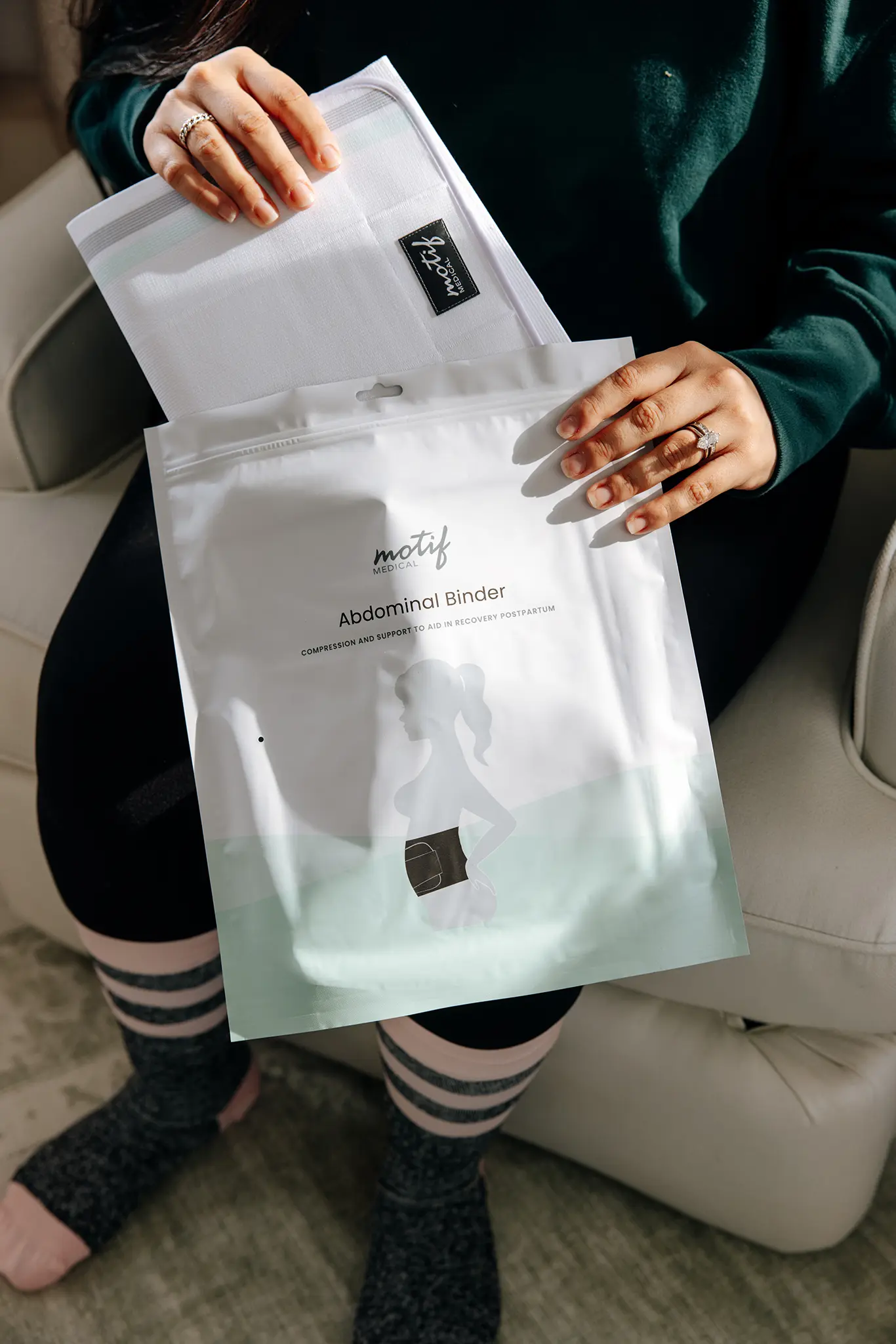
Gentle core support for the first weeks after delivery - covered by most insurance.
A medical-grade postpartum abdominal binder designed for the body that just delivered a baby - whether by C-section or vaginally. Adjustable compression supports your incision, tender core, and aching lower back so you can stand up, walk, lift the baby, and breathe a little easier. We handle the prescription, the insurance paperwork, and ship it straight to you.
Roughly 1 in 3 U.S. births is now a C-section (CDC, 2024), and around 60% of postpartum women still have some degree of diastasis recti at six weeks. Gentle abdominal compression is one of the simplest, drug-free things clinicians can offer to take pressure off the incision, stabilize the core, and make those first weeks of standing, walking, and lifting feel a little less impossible.
Prescription required. Our care team coordinates the Rx
with your provider — no chasing paperwork.
Why moms choose it
What sets Abdominal Binder
apart.
Supports your core after C-section or vaginal delivery
After delivery your abdominal wall is stretched, the muscles are weakened, and (if you had a C-section) there's a healing incision underneath. Gentle, even compression holds everything in place so the work of standing up, getting out of bed, and walking to the bathroom isn't being done by a core that isn't ready yet.
Reduces post-cesarean pain and helps you move sooner
A 2020 randomized controlled trial and follow-up meta-analyses found elastic abdominal binders significantly reduced pain at 6, 12, 24, and 48 hours after cesarean delivery and improved early ambulation. ACOG's postpartum pain management guidance lists abdominal binders as a reasonable non-pharmacologic option after cesarean.
Supports diastasis recti recovery
About 60% of women still have measurable abdominal separation at six weeks postpartum and roughly a third at 12 months. A binder doesn't "close" the gap on its own, but it gives your linea alba and deep core a stable foundation to work from while you do the pelvic-floor and core rehab that actually retrains those muscles.
Helps with posture and lifting the baby
Carrying, feeding, and lifting a newborn dozens of times a day puts real load on a core that hasn't recovered yet - which is why so many moms end up with lower-back and SI-joint pain in the first months. Light compression cues you back into a neutral posture and offloads some of the strain when you're hunched over the crib or the car seat.
Adjustable compression with hook-and-loop closure
Wide hook-and-loop panels let you dial the compression up or down as the day goes on - looser after meals or during feeding, snugger when you're up walking. As swelling drops over the first six weeks, the binder shrinks down with you instead of becoming unwearable at week three.
Breathable, medical-grade fabric
Built from a breathable medical-grade elastic knit that wicks moisture and won't trap heat against a healing incision. Low-profile enough to disappear under a nursing tank or loose dress so you can actually wear it through the day without anyone noticing.
Sized for the postpartum body
Sizing runs S–XXL and is fitted to your postpartum measurements, not your pre-pregnancy jeans size - most moms land one or two sizes up from where they expected. We send measurement guidance with your order so the fit is right the first time.
Latex-free and skin-safe
Latex-free materials throughout, with soft-edge binding so it doesn't dig into a fresh incision or sensitive postpartum skin. Safe for sensitive-skin and latex-allergic moms.
The details
Specs & specifications.
Support type
Postpartum abdominal compression binder
Sizing
S–XXL, fitted to postpartum measurements
Material
Medical-grade elastic knit, latex-free
Closure
Wide hook-and-loop, adjustable compression
Indication
Post-cesarean, diastasis recti, core/back support
Wear duration
6–8 wks postpartum, 8–12 hrs/day
Rx required
Yes - for insurance coverage
How it works
How to get your Abdominal Binder order.
1
Tell Us About Your Plan
Enter your insurance details and due date. It takes about two minutes - we'll verify your coverage instantly, no phone calls required.
2
We Coordinate the Prescription
Most maternity-support items require a quick prescription from your provider. Our care team handles the outreach so you don't have to chase paperwork.
3
We Ship It to Your Door
Once your order is approved, we ship directly to you - free. Most moms receive their order within 3-5 business days.
U.S. births delivered by cesarean (CDC, 2024 - 32.4% cesarean rate)
Insurance coverage
Covered by most major insurance - no cost to you in most cases.
Under the Affordable Care Act, postpartum recovery supplies prescribed as medically necessary are commonly covered as durable medical equipment (DME). Abdominal binders are typically billed under HCPCS code L0621 with ICD-10 diagnoses like post-cesarean recovery, postpartum back pain (O99.89), or diastasis recti (M62.08) - all common, well-documented postpartum indications that insurance plans recognize.
Aetna
Blue Cross Blue Shield / Anthem
Cigna
UnitedHealthcare
Humana
TRICARE
Medicaid (most state plans)
Molina Healthcare
Wellpoint
Ambetter
Coverage, copays, and deductibles vary by plan. Run a 2-minute benefits check and we'll tell you exactly what your plan covers before you commit to anything.
Why moms trust 1 Natural Way
for Abdominal Binder.
We do the insurance work for you. No calling carriers, no claim forms, no hold music. We verify your coverage, coordinate with your provider, and handle the paperwork.
IBCLC-led care, every step. Every maternity-support order is paired with access to our care team - board-certified lactation consultants, dietitians, and OB-trained specialists who know what actually helps.
Curated, not crowdsourced. We don't carry junk. Every product on our maternity-support shelf is clinically vetted, mom-tested, and the one we'd recommend to a friend.
Reorder anytime. Refills, replacements, and add-ons all live in your account. One login, one care team, the whole arc of pregnancy and postpartum.
Reviews
What moms say about 1 Natural Way.
"I had no idea my insurance covered compression stockings until I checked with 1 Natural Way. They handled everything - I just had to measure my legs and wait for the package."
— Amanda R., Verified Customer
"The MilkZoom program is a lifesaver. Fresh pump parts show up automatically and I don't have to think about it. My pump works so much better now."
— Jessica M., Verified Customer
"Getting the Owlet BabySat through insurance was so much easier than I expected. 1 Natural Way coordinated with my pediatrician and handled all the paperwork."
— Sarah K., Verified Customer
FAQ
Abdominal Binder: your questions answered.
Yes - most major insurance plans, including Aetna, BCBS/Anthem, Cigna, UnitedHealthcare, TRICARE, Medicaid, Kaiser, and others, cover a postpartum abdominal binder as durable medical equipment when prescribed as medically necessary. Coverage is most consistent after a C-section or with a documented diastasis recti or postpartum back-pain diagnosis. Most eligible moms have no out-of-pocket cost.
Yes. Insurance requires a prescription from your OB, midwife, or primary-care provider to cover an abdominal binder. You don't need to handle this yourself - once you place your order with 1NW, we collect the prescription and medical documentation directly from your provider's office.
Most clinicians clear moms to start wearing a binder within the first day or two after delivery, including after a C-section, as long as your provider has approved it. For C-section recovery specifically, gentle compression in the first 24–48 hours is when the pain-relief and mobility benefits show up most clearly in clinical trials. Always check with your delivering provider before you start.
Start with 2–3 hour intervals for the first few days, then build up to 8–12 hours per day during waking, active hours. Take it off at night so your skin (and, if applicable, your incision) can breathe. The binder is most useful when you're upright, walking, or lifting - less useful when you're resting in bed.
Yes, it's safe - and the evidence is reasonably strong that it helps. Multiple randomized trials and a 2021 meta-analysis found elastic abdominal binders reduced post-cesarean pain at 6, 12, 24, and 48 hours, improved early ambulation, and reduced pain interference with breastfeeding, with no increase in complications. ACOG's postpartum pain guidance lists it as a reasonable non-drug option. For more on healing well, see our post-C-section recovery guide.
Not on its own. A binder supports your abdominal wall and gives your deep core a stable platform to work from, but the gap between your rectus muscles closes through targeted core and pelvic-floor rehab - ideally with a pelvic-floor physical therapist. About 60% of women still have measurable separation at six weeks postpartum and roughly a third still do at a year, so this is normal, and recovery is real but takes work.
Most providers recommend wearing a binder for the first 6–8 weeks postpartum, tapering off as your core regains strength. Some moms keep using it situationally beyond that - long days on their feet, travel, or workouts where they want extra core support - but it's not meant to be worn 24/7 long-term.
No - a postpartum abdominal binder sits below the chest and doesn't restrict the breasts or interfere with letdown, latch, or pumping. One of the documented benefits is actually that it reduces the pain that can interfere with breastfeeding positioning after a C-section.
Sizing is based on your postpartum measurements, not your pre-pregnancy size. Most moms end up one or two sizes larger than they expect because the abdomen, hips, and waist all change through pregnancy and don't snap back immediately. We send measurement guidance with your order - measure at the widest part of your belly while standing, not pre-pregnancy.
Once your provider clears you for exercise (usually after your 6-week postpartum check), a binder can add support for walking, light strength work, and early core rehab. Don't use it as a substitute for rebuilding your core, though - and if you're working with a pelvic-floor PT, follow their guidance on when and how to use it during workouts.
Run a 2-minute benefits check on our site. We'll verify your coverage, then we contact your provider for the prescription and ship your binder straight to you. Most moms have it in hand within a few days, with no paperwork on your end and no upfront cost if your plan covers it.
This page is for general information and is not medical advice. An abdominal binder is a supportive tool, not a substitute for postpartum rehab or pelvic-floor physical therapy. Talk with your OB, midwife, or pelvic-floor PT about when to start, how to use it, and how it fits into your broader recovery plan - especially if you had a C-section, a complicated delivery, or symptoms like pelvic pain, heaviness, leaking, or persistent abdominal separation.
Ready to get started
with Abdominal Binder?
Run our 2-minute coverage check. We'll verify your benefits, coordinate any
prescription, and ship directly to your door.