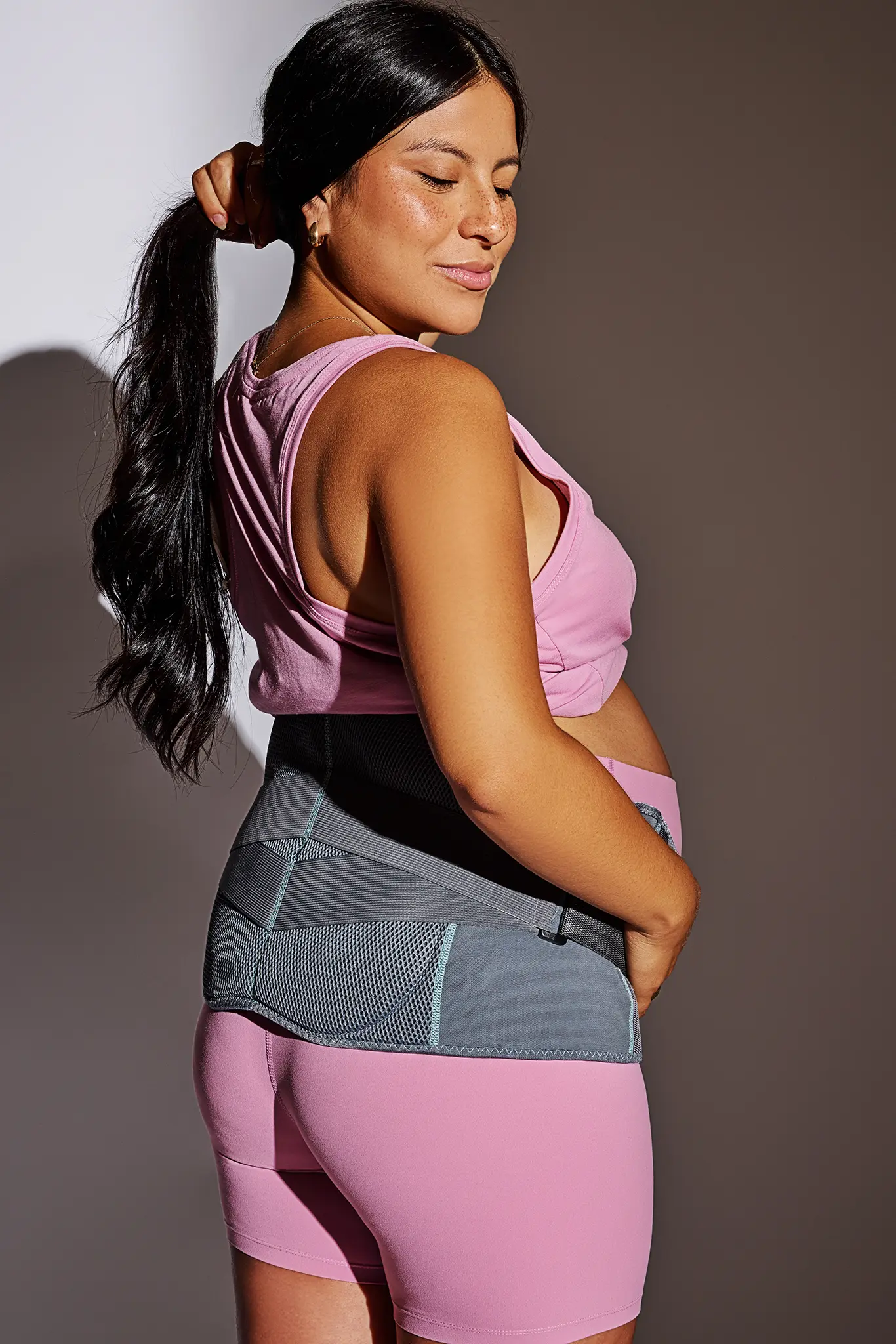
Pregnancy lumbar support that takes the weight off your back - covered by insurance.
A medical-grade maternity belt that lifts the belly, stabilizes the pelvis, and gives your lower back real relief through the second and third trimester. Most insurance plans cover it with a prescription, often at no cost to you. Our team handles the paperwork from your OB to your front door.
By the third trimester, your center of gravity has shifted forward, your ligaments have softened, and the muscles holding everything together are working overtime. A properly fit lumbar support won't fix every ache - but for most moms, it turns standing, walking, and getting through a workday from "white-knuckling it" back into something close to normal.
Prescription required. Our care team coordinates the Rx
with your provider — no chasing paperwork.
Why moms choose it
What sets Lumbar Support
apart.
Relieves lower-back and SI joint pain
The dual lumbar panel adds external compression across the sacroiliac (SI) joints, the two spots at the base of your spine that take the brunt of pregnancy's ligament loosening. Most moms feel the difference within the first few minutes of putting it on - less stabbing pain when you stand up, less ache when you sit back down.
Supports a growing belly
A soft, contoured abdominal lift band cradles the bump from below and gently redistributes its weight off your lower back. It's the difference between your spine carrying every ounce and your belt sharing the load - especially noticeable in third trimester, with twins, or with a lower-sitting baby.
Takes pressure off your pelvic floor
By lifting the uterus up and forward, the belt reduces the downward drag on your pelvic floor and bladder. Many moms report fewer "lightning crotch" jolts, less round-ligament pain, and noticeably less urinary urgency on long walks or shopping trips.
Adjustable as you grow
Hook-and-loop closures on both the abdominal band and the lumbar panel let you re-fit the belt week by week as your bump changes. One belt covers you from roughly 20 weeks through delivery - no need to size up mid-pregnancy.
Breathable and wearable under clothes
Latex-free elastic mesh and a low-profile silhouette mean the belt disappears under a tee, work blouse, or activewear. Built for all-day wear without overheating, even in summer.
Postpartum-friendly
Flip the belt and the same panel becomes light postpartum abdominal compression - supporting the core, hips, and incision area in the first weeks after vaginal or C-section delivery (with your provider's clearance).
Doctor-recommended for active days
Recommended by OB-GYNs, midwives, and pelvic-floor PTs for moms who are on their feet for long stretches - teachers, nurses, retail workers, anyone chasing a toddler. Use it for the parts of the day that demand the most from your back, not necessarily 24/7.
Designed for second and third trimester onward
Most providers recommend starting once the bump starts pulling on your back - typically around 20-24 weeks - and continuing through delivery. Some moms with prior back injuries, multiples, or hypermobility benefit from starting earlier.
The details
Specs & specifications.
Support type
Abdominal lift + dual lumbar/SI panel
Sizing
S-XXL, fits 2nd & 3rd trimester
Material
Breathable elastic mesh, latex-free
Indication
Pregnancy back/SI pain, SPD, pelvic girdle pain
Postpartum use
Light compression with provider clearance
Rx required
Yes - for insurance coverage
How it works
How to get your Lumbar Support order.
1
Tell Us About Your Plan
Enter your insurance details and due date. It takes about two minutes - we'll verify your coverage instantly, no phone calls required.
2
We Coordinate the Prescription
Most maternity-support items require a quick prescription from your provider. Our care team handles the outreach so you don't have to chase paperwork.
3
We Ship It to Your Door
Once your order is approved, we ship directly to you - free. Most moms receive their order within 3-5 business days.
Pregnant women who experience low back pain at some point during pregnancy or postpartum (NIH/PMC)
Insurance coverage
Most major plans cover a maternity support belt with a prescription.
Maternity support belts are routinely covered as a DME benefit under the Affordable Care Act when prescribed for pregnancy-related back, pelvic, or SI pain. We bill your plan directly - most moms pay nothing out of pocket.
Aetna
Blue Cross Blue Shield / Anthem
Cigna
UnitedHealthcare
Humana
TRICARE
Medicaid (state plans vary)
Molina Healthcare
Wellpoint
Ambetter
Coverage hinges on the right ICD-10 diagnosis code (commonly O99.89 or M54.5 for pregnancy-related back pain) paired with HCPCS code L0625 or L0627 for the lumbar-sacral orthosis. We handle the coding on the claim - you and your provider just need the prescription.
We do the insurance work for you. No calling carriers, no claim forms, no hold music. We verify your coverage, coordinate with your provider, and handle the paperwork.
IBCLC-led care, every step. Every maternity-support order is paired with access to our care team - board-certified lactation consultants, dietitians, and OB-trained specialists who know what actually helps.
Curated, not crowdsourced. We don't carry junk. Every product on our maternity-support shelf is clinically vetted, mom-tested, and the one we'd recommend to a friend.
Reorder anytime. Refills, replacements, and add-ons all live in your account. One login, one care team, the whole arc of pregnancy and postpartum.
Reviews
What moms say about 1 Natural Way.
"I had no idea my insurance covered compression stockings until I checked with 1 Natural Way. They handled everything - I just had to measure my legs and wait for the package."
— Amanda R., Verified Customer
"The MilkZoom program is a lifesaver. Fresh pump parts show up automatically and I don't have to think about it. My pump works so much better now."
— Jessica M., Verified Customer
"Getting the Owlet BabySat through insurance was so much easier than I expected. 1 Natural Way coordinated with my pediatrician and handled all the paperwork."
— Sarah K., Verified Customer
FAQ
Lumbar Support: your questions answered.
Yes, in most cases. Maternity lumbar support belts are classified as durable medical equipment (DME) and are covered by most commercial insurance plans, Medicaid, and TRICARE when prescribed by a licensed provider for a pregnancy-related musculoskeletal condition. Coverage and any cost share depend on your specific plan - we verify your benefits in under two minutes before anything ships.
Yes. To bill insurance, we need a prescription from your OB-GYN, midwife, or primary care provider citing a covered diagnosis (usually pregnancy-related low back pain, SI joint dysfunction, or symphysis pubis dysfunction). If you don't already have a prescription on file, we'll request it from your provider directly - you don't need to make a separate appointment.
Most moms start between 20 and 24 weeks - around the point the bump begins pulling forward on your lower back. If you have a history of back pain, are carrying multiples, are hypermobile, or your job keeps you on your feet, your provider may recommend starting earlier. There's no medical benefit to waiting until the pain is severe; the belt works best as prevention. Read more about the benefits of a pregnancy support band.
No. A properly fitted maternity support belt sits on the muscles and pelvis surrounding your uterus, not on the baby. It applies gentle external support - not compression on the womb - and is specifically engineered to be safe through every trimester. Your baby's movement, fluid, and space are unaffected. If anything ever feels too tight, loosen the hook-and-loop closures; the fit should be snug and supportive, never restrictive.
Most providers recommend two to three hours at a stretch, with breaks, for a total of up to about eight hours per day. Wear it for the parts of your day that demand the most from your back - long shifts, walks, errands, standing meetings - and take it off when you're resting or reclined.
No - take the belt off before bed. Sleeping in a support belt can over-restrict circulation and prevents the muscles that the belt assists from doing their natural work overnight. If lower-back pain is keeping you up, a pregnancy pillow between the knees is the more evidence-based fix.
Not exactly. A maternity support belt is built around an abdominal lift band designed to hold a growing belly up and forward, with lumbar paneling to stabilize the SI joints. A postpartum binder is built around all-the-way-around abdominal compression designed to support the core, hips, and (after a C-section) the incision as everything reknits. Some products convert between the two roles, but a dedicated postpartum binder offers firmer, more circumferential compression for the recovery window.
Yes, with your provider's clearance - typically at your two-week or six-week check. The belt's lumbar panel and abdominal band offer light compression that helps in the first few weeks postpartum as your core re-engages. For longer or firmer postpartum support (especially after a C-section), most moms move to a dedicated postpartum recovery garment, which we also cover through insurance.
Sizing is based on your pre-pregnancy hip measurement, not your current belly. Our size guide on the product page maps S-XXL to specific measurements; if you're between sizes, size up - the hook-and-loop closures let you tighten down, but they can't stretch a belt that's too small. If you're unsure, our team will size you over the phone.
Three steps and we handle the rest: (1) verify your insurance benefits using the form on this page - takes about two minutes; (2) we contact your OB or midwife for the prescription; (3) your belt ships free to your door, billed to your insurance. No upfront payment, no paperwork on your end.
This page is for general informational purposes and is not a substitute for medical advice. A maternity lumbar support belt is one tool for managing pregnancy-related back and pelvic pain - talk to your OB-GYN, midwife, or pelvic-floor physical therapist about whether it's right for you, especially if you have severe pain, sciatic symptoms, a history of pelvic surgery, or any pregnancy complications.
Ready to get started
with Lumbar Support?
Run our 2-minute coverage check. We'll verify your benefits, coordinate any
prescription, and ship directly to your door.